
Engineering resource · Adhesive constructions
What Is the Difference Between Transfer Adhesive, Double-Sided Tape and Adhesive-Backed Foam?
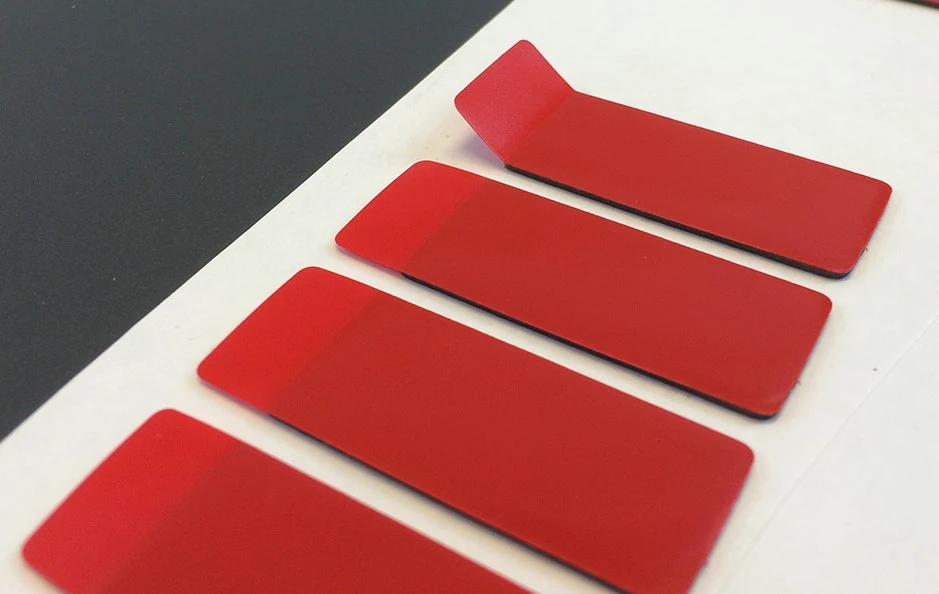
Adhesive transfer tape usually leaves a pressure-sensitive adhesive (PSA) layer without a separate permanent carrier. Carrier-backed double-sided tape retains a supporting layer between its adhesive faces. Adhesive-backed foam combines a functional foam with an adhesive construction. The choice depends on what must remain in the joint, which surfaces must bond, and whether the assembly also needs the foam's contact or deformation behavior. [1, 2]
These terms overlap. Transfer tape can fall within the broader category of double-sided tapes, and either a transfer adhesive or a carrier-backed tape can be used to add adhesive backing to foam. For this comparison, "double-sided tape" means a carrier-backed, double-coated construction. This keeps the adhesive's supporting structure separate from the foam's function. [2, 3, 5]
What remains after the release liner is removed
Start with the permanent layers. A release liner protects the adhesive and supports handling until the relevant face is exposed for bonding. A carrier remains inside the installed tape. Keeping those roles separate makes the following constructions easier to compare. [1, 2]
Typical constructions and permanent layers
| Construction | Typical permanent layers | Function to evaluate |
|---|---|---|
| Adhesive transfer tape | Adhesive without a separate permanent carrier | Surface contact and support during placement |
| Carrier-backed double-coated tape | Adhesive / carrier / adhesive | Two bonding faces, with support determined by the carrier |
| Foam with one external adhesive face | Functional foam plus a specified adhesive construction, which may include a carrier | Foam contact or cushioning, plus attachment to one mounting surface |
| Double-sided foam bonding tape | A defined foam bonding structure with two external adhesive faces | Joining two surfaces and managing the joint's deformation |
Swipe horizontally to view all columns.
The table shows typical arrangements. Specialized foam tapes and other constructions should be described using their actual layers. [1, 9]
Liner count is a separate specification. For example, 3M 7952MP is a transfer adhesive with primary and secondary release liners. Its September 2024 technical data sheet lists both liners separately. A transfer adhesive can therefore have two liners and still have no permanent internal carrier. [4]
A foam sheet laminated with a carrier-backed tape retains the foam, the tape's adhesive coatings, and its carrier. One adhesive coating bonds to the foam; the other can become the exposed mounting face. The finished foam component may have one external adhesive face while containing a double-coated tape internally. [3]
How does a carrier change conformability and handling
For a soft part that changes shape while being lifted or positioned, a carrier-backed construction is worth comparing. The carrier can help the laminate retain its shape during handling. In 3M 9495LE, for example, the polyester film is specifically identified as a way to add dimensional stability to foams and other substrates. [3]
A part that must follow a contour brings a different requirement. Adding a permanent carrier changes the construction that must bend with the part. A transfer layer omits that separate carrier, while its liner can still provide temporary support during application. Evaluate the support needed at each stage of liner removal together with the flexibility required after installation. [2, 4]
Carrier material changes that trade-off. tesa describes film backings as dimensionally stable and nonwoven backings as conformable. A supported tape can therefore offer a different balance depending on its backing. Compare actual cut parts when handling matters: the behavior of a soft frame during peeling and placement may differ from that of an uncut sheet. [6]
Separate carrier thickness from adhesive thickness when considering a textured surface. Additional carrier thickness increases the permanent stack without necessarily adding adhesive where contact is needed. 3M's 200MP application guidance distinguishes smooth, flexible interfaces from textured or rigid ones when discussing adhesive thickness. Use that guidance within its stated adhesive and substrate conditions, and evaluate contact on the actual surfaces. [5]
Where the two mating materials have different bonding needs, a double-coated tape can use different adhesives on its two sides. Specify which face meets which material. A carrier that helps a foam part hold its shape does not, by itself, establish adhesion to the foam surface or to a painted housing. [1, 2, 3]
When should the design include adhesive-backed foam
Compare a foam construction when the assembly needs compressible contact, cushioning, or a compliant bonded joint. In a compression gasket arrangement, adhesive may hold the foam on one panel before the mating part closes against it. The exposed foam face then provides the required contact. Saint-Gobain's Norseal A Foam is one manufacturer example of a foam sealing product with PSA on one side. [8, 10]
The foam must work within the actual gap and the available closure force. Insufficient compression can leave incomplete contact, while excessive compression can increase closure difficulty or deform the assembly. Adhesives, carriers, and other permanent layers occupy part of the available space. Account for them when relating free foam thickness to the installed gap. [10]
A double-sided foam bonding tape has to connect both mating surfaces. Its foam may also contribute the compliance needed by the joint. For example, 3M VHB 5930 has a specified acrylic foam construction, and its data sheet explains how load rate and duration affect its viscoelastic behavior. Those properties belong to that identified construction and should not be assigned to an unspecified foam with adhesive backing. [9]
Keep the verification tied to the function. A compression seal needs adequate contact and acceptable closure behavior in its assembled geometry. A foam bonding joint needs acceptable adhesion and load response over the required service conditions. Adhesive attachment alone does not establish a sealing result, and a foam tape's ability to accommodate slight irregularities does not make it a filler for arbitrary gaps. [9, 10]
Which thickness should be specified
Specify the permanent construction thickness and state which layers it includes. Keep liner thickness separate when comparing supply formats. For foam parts, also distinguish free thickness from the installed state: the space available to the foam changes when adhesive, carrier, or other permanent layers share the same gap. [3, 4, 10]
The example below uses typical values from the September 2024 data sheets for 3M 9495LE, English-US, and 3M 7952MP, English-EU. The values are expressed in micrometers (µm). In 9495LE, the listed 170 µm tape total comprises 71 µm of adhesive, a 13 µm carrier, and another 86 µm of adhesive. [3, 4]
Nominal layer sums using published typical values
| Construction | Permanent tape total µm | Release liner layers µm | Sum including listed liners µm |
|---|---|---|---|
| 3M 9495LE supported tape | 170 | One layer of 110 | 280 |
| 3M 7952MP transfer tape | 60 | Two layers of 110 | 280 |
Swipe horizontally to view all columns.
Both nominal sums are 280 µm, although the listed permanent tape totals are 170 µm and 60 µm. The sums simply add the rounded data sheet values for flat layers and do not model additional compression. When the stated liners are removed from the bonding faces, those liners no longer occupy the joint. These are illustrative layer calculations, not delivered-material measurements, acceptance tolerances, or evidence of interchangeability. [3, 4]
Transfer and supported tapes can also overlap in thickness. tesa's published LSE comparison includes a transfer tape thicker than the PET-backed tape beside it. Use the actual grades and thickness definitions when checking a restricted permanent stack. [7]
What should be tested before approving a construction
Run the intended liner-removal and placement sequence with the actual cut part. Observe whether its shape or position changes before bonding. If handling is the problem, compare carrier support and liner presentation as part of the construction assessment. An adhesive's peel result will not tell you whether a soft frame can be positioned accurately. [3, 4]
Use representative production surfaces for adhesion trials and apply the selected material under its specified conditions. Where the construction includes foam, use the actual foam surface and mounting finish. Record what happens at the foam-to-adhesive interface separately from the mounting interface. That observation helps define the next material or application condition to compare without treating one visible symptom as a complete diagnosis. [3, 5]
Match the load evaluation to the joint. Edge lifting introduces a different demand from sustained sliding parallel to the bonded surfaces. Peel and static shear data therefore answer different questions. A result also depends on its substrate, temperature, dwell time, and test setup. For viscoelastic foam bonding tapes, short-term resistance does not by itself establish acceptable behavior under a sustained load. [3, 9, 11]
For a compression foam part, check the installed gap, closure behavior, and required contact as well as attachment. Set the acceptance criteria from the drawing and the assembly's functional requirements. The following illustrative situations show how these checks change the construction worth comparing. [8, 10]
Illustrative selection situations
| Assembly task | Construction to compare | Reason for considering it | Check that changes the choice |
|---|---|---|---|
| Thin flexible part on a relatively flat surface | Transfer adhesive; thin supported tape if handling needs it | Balance permanent thickness, contact, and handling | Actual surface contact, permanent thickness, and placement |
| Soft foam frame that distorts during placement | Supported adhesive construction and liner options | Add handling support while retaining needed flexibility | Shape and position after peeling and placement |
| Foam fixed to one panel before compression | Foam with one external adhesive face | Combine location with a separately defined foam function | Actual gap, closure force, contact, and attachment |
| Two surfaces needing a compliant bonded joint | A specified double-sided foam bonding tape versus a thin construction | Compare joint response and available space | Actual surfaces, sustained load, environment, and gap |
Swipe horizontally to view all columns.
For a custom adhesive component, send TC Precision Components a layer sketch or drawing identifying the mating surfaces, available permanent thickness, and the foam's role, if any. Include how the part will be peeled and placed so the project can be discussed in the context of the assembly.
References
The source numbering follows the supplied English manuscript. Web sources were accessed on November 6, 2026.
[1] Pressure Sensitive Tape Council (PSTC). PSA Tape Defined. Web page.
[2] 3M. Double Coated and Adhesive Transfer Tape for Thin Bonding. Web page.
[3] 3M. 3M Double Coated Tape 9495LE. Technical Data Sheet English-US September 2024 pages 1 to 3.
[4] 3M. 3M Adhesive Transfer Tape 7952MP. Technical Data Sheet English-EU September 2024 page 1.
[6] tesa. Carrying adhesion to the peak. A brief look on backings. Updated July 9 2024.
[7] tesa. LSE – Mounting Solutions. Web page.
[8] Saint-Gobain Tape Solutions. A Foam / Norseal A Foam. Web page.
[9] 3M. 3M VHB Tape 5930. Technical Data Sheet English-US September 2024 pages 1 to 4.